Unlike IELTS Writing Task 2 which challenges candidates to engage in argumentative writing, Writing Task 1 requires candidates to present descriptive writing of diagrams, particularly graphs or charts. Writing Task 1 and 2 are two distinct genres and candidates should apply unique strategies to achieve a successful band in writing.
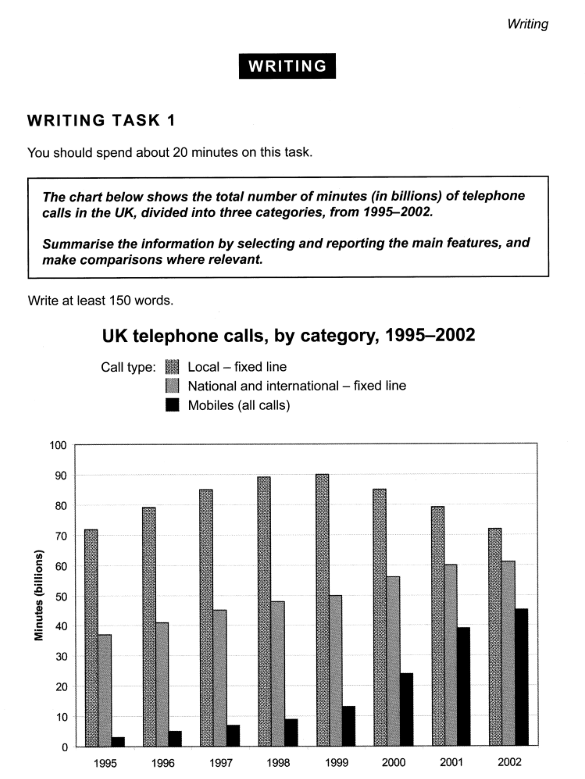
Source: Cambridge English IELTS 9, p. 53
Here are some strategies performed by candidates who achieved band 8.0 in IELTS Writing Task 1, including the models written by examiners:
1. Write an introductory sentence by paraphrasing the question
A single sentence can start Writing Task 1 Graph because the genre is descriptive writing.
To write an introductory sentence, IELTS examiners expect candidates to paraphrase the question effectively. There are certainly keywords which will not be paraphrased, such as names of a city or country and period of time (most commonly years). However, candidates can paraphrase the content words in the question, such as nouns and verbs. Below is the example of paraphrasing in Writing Task 1:
Question: The chart below shows the total number of minutes (in billions) of telephone calls in the UK, divided into three categories, from 1995-2002.
Introductory sentence: The bar graph indicates the time spent by UK residents on distinct types of telephone calls between 1995 and 2002.
2. Write a summary
In Writing Task 1 Graph, a summary is presented to provide general information about the graph. There are two types of a summary in Writing Task 1 Graph: (1) Overview, written at the beginning after the introductory sentence, (2) Conclusion, written at the end of the entire description.
Successful candidates usually opt for writing an overview. However, a number of model writings exemplified by IELTS examiners present the summary as a conclusion. Here are some common strategies in writing a summary:
- Compare the trend of each core variable (i.e. to rise, fall, fluctuate, remain stable).
- Compare the gap of each core variable at the beginning and at the end of the period in question.
3. Well-organised body paragraphs
Candidates will write body paragraphs by presenting 3 or 4 most striking features of the graph. In other words, candidates should report highlights and will not write every single detail of trends in the graph.
Successful candidates organise their body paragraphs in Writing Task 1 Graph well based on the core variables. For example, when there are 3 core variables shown in the graph, candidates can write 3 body paragraphs.
4. The beginning and ending of trends are keys.
Candidates should pay more attention to the beginning and the ending of each core variable to decide whether its pattern is to increase, decrease, fluctuate, or stagnate. Some model writings produced by examiners mention the beginning and ending of each trend to start the description of the body paragraph, followed by elaboration of the overall pattern.
IELTS Writing Task 1 can be more challenging than Writing Task 2 for a number of candidates. However, by knowing some strategies and having further practice, IELTS Writing Task 1 can be helpful to enhance the overall writing assessment.
Author: Norma Sholikah
The contents of this website are Planet English copyright.
 Planet English Online
Leave a comment